ASU Polytechnic
A design system for the Technology, Entrepreneurship and Management program — built as a grid so future cohorts inherit rules instead of reinventing a logo.
- Role
- Project Manager & Brand Designer
- Year
- 2026
- Context
- ASU GIT Design Agency
- Scope
- Identity · Grid system · Templates
Every cohort was reinventing the same logo.
ASU's Technology, Entrepreneurship and Management program wanted branding that didn't read as generic ASU. What it actually needed was rules — without them, each incoming class risked another mismatched stack of flyers across Polytechnic.
Our professor pushed the brief past a one-off mark and into a real system, on the argument that a logo solves this semester and a system solves the next five.
Audit what exists, then study who solved it properly.
We audited what communications and facilities already published, then compared MIT-style systematic lab identities to understand how a grid can enforce consistency without flattening every program into the same mark.
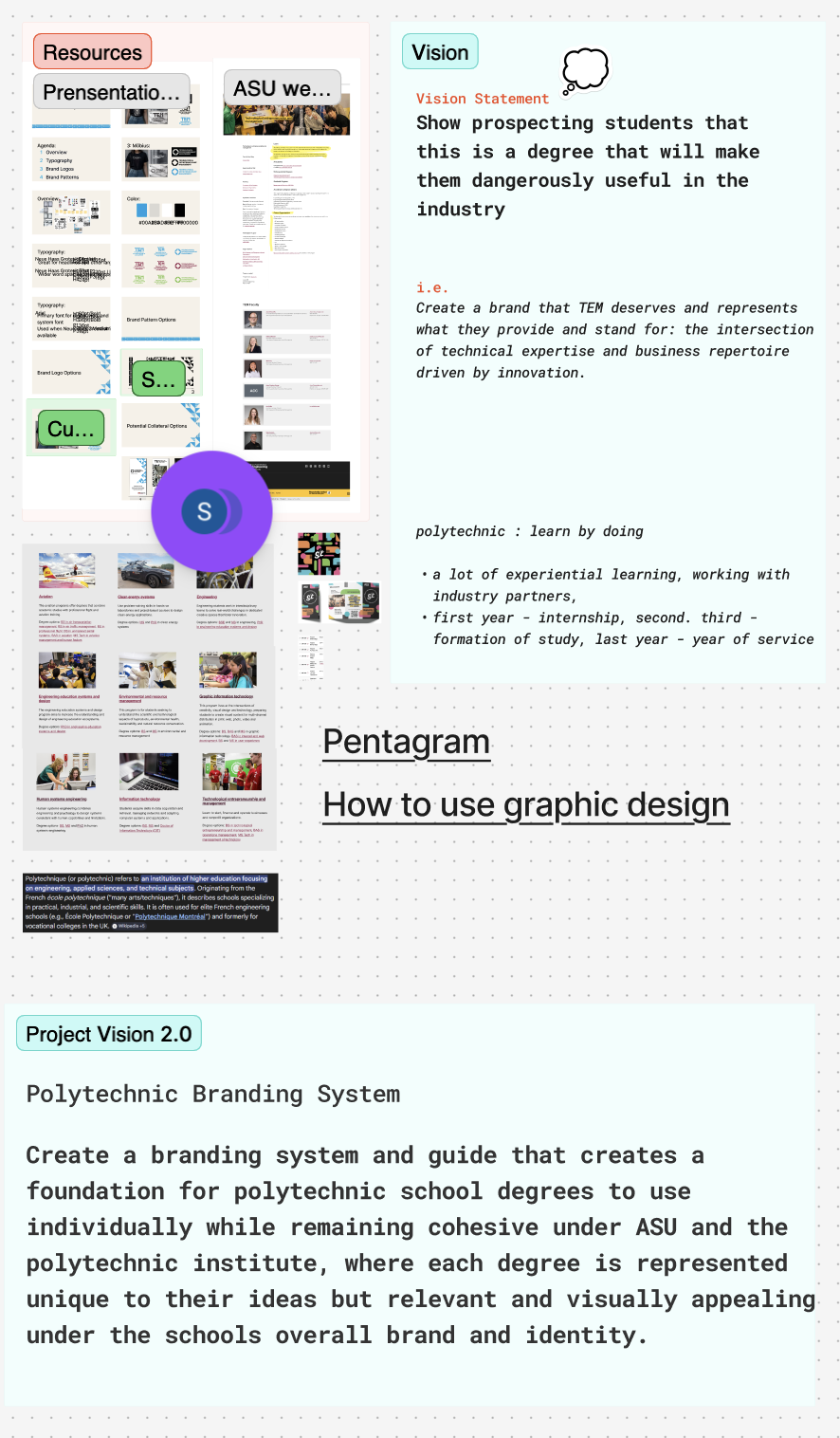
Team critiques ran in FigJam so priorities and file drops stayed visible to everyone, not buried in one person's drive.
A hex isometric grid and a Mother Shape.
The system is built on a 6×6 isometric grid with a cuboid language that reads as 3D. A shared silhouette — the Mother Shape — flexes across formats while staying recognizably one family.
Color was chosen for Arizona outdoor media first, where signage sits in hard sun all year, rather than for how it looks on a calibrated screen.
Packaged so a vendor never has to guess.
Figma libraries, signage specs, InDesign and Canva templates, and training decks for partners — with export presets so vendors and student makers aren't guessing at trim or color.
Canva sits alongside Figma deliberately: the people making a last-minute flyer are not always designers.
Presented to the Dean of Operations for implementation.
I presented the mark and the system it sits inside to the Dean of Operations — not as a concept review, but as a proposal for adoption across Polytechnic. Explaining how student work and official communications could share one grid was the whole argument.
Handoff was versioned zips plus office hours — a system nobody knows how to use is a PDF, not a system.